Transcript
0:00What is bioavailability?
Lesson 2.4 of our absorption module: bioavailability. Absorption is the movement of a drug from the site where it is given into the systemic circulation. Bioavailability, F, is the fraction of a dose that reaches the systemic circulation unchanged. An intravenous dose enters the systemic circulation directly, so its F is 1 by definition. A dose by any other route must first be absorbed, and part of the dose can be lost on the way. Its F can then be less than 1. Regulators use the word bioavailability for both the rate and the extent of absorption.
0:47Fa, Fg and Fh
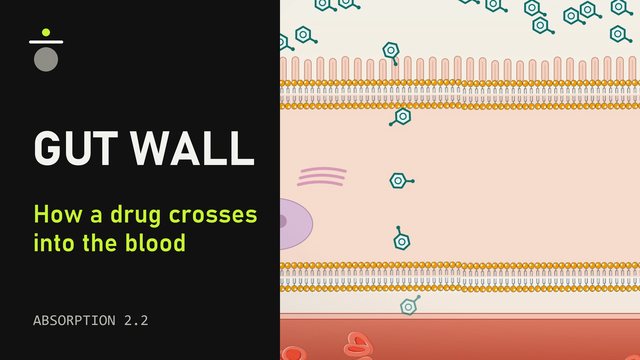
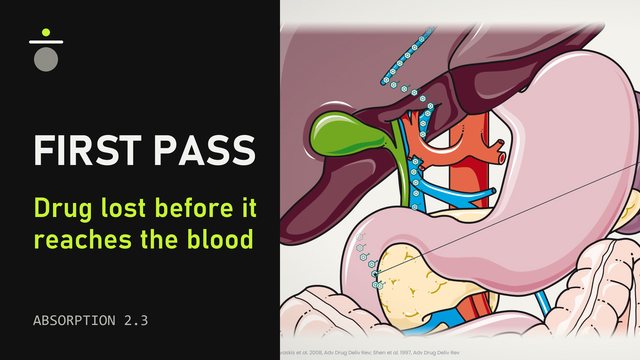
For an oral dose, the drug reaches the systemic circulation only after it passes through the gut wall and the liver. Three fractions therefore set F. Fa, the fraction absorbed, is the fraction of the dose that crosses into the gut wall. In this formula, this step is called absorption. Fg is the fraction of drug that enters the gut wall and escapes metabolism there. Fh is the fraction of drug that enters the liver and escapes metabolism there. F equals Fa times Fg times Fh. For example, with an Fa of 0.9, an Fg of 0.8 and an Fh of 0.5, F is 0.36, or 36 percent.
1:39Absolute bioavailability
Three types of study compare bioavailability: absolute bioavailability, relative bioavailability and bioequivalence. The first is absolute bioavailability, F measured against an intravenous dose. In a crossover study, the same people receive both doses on separate occasions. After each dose, the study measures the plasma concentration over time. The AUC is the area under the curve of concentration against time. The AUC equals the amount of drug that reaches the systemic circulation divided by the clearance. Clearance is the volume of plasma from which the body removes all of the drug per unit of time. F is therefore the oral AUC divided by the intravenous AUC, after each AUC is divided by its dose. The calculation assumes that clearance is the same on both occasions. When the two doses differ, it also assumes that the AUC rises in proportion to the dose. Each person receives both doses, so each person serves as his or her own control. Differences in clearance between people then cancel in the ratio.
3:05Relative bioavailability
The second type is relative bioavailability. It compares two products of the same drug, or two ways of giving it, without an intravenous dose. An example is a tablet and an oral solution. The calculation uses the same ratio of dose-normalized AUC values, with one product as the reference. A relative bioavailability of 100 percent means that the two products deliver the same fraction of the dose to the systemic circulation.
3:41Bioequivalence
The third type is bioequivalence. Two products are bioequivalent when their rate and extent of absorption agree within set limits. Regulators use the AUC as the measure of the extent, and the peak plasma concentration, Cmax, as the measure of the rate. For each, they calculate the ratio of the test product, the new product, to the reference product. They use geometric means, which they calculate from the logarithms of the values. A confidence interval is the range that is likely to contain the true ratio. For most products, the 90 percent confidence interval of this ratio must lie between 80 and 125 percent. Scientists at the US Food and Drug Administration analyzed 2,070 bioequivalence studies of approved generic products. On average, the AUC of the generic product differed from that of the brand-name product by 3.56 percent.
4:53Apixaban
Apixaban gives an example of each type of study. Apixaban is an oral inhibitor of factor Xa, an enzyme of blood coagulation. It is a substrate of the enzyme CYP3A4 and of P-gp, a pump that moves drugs out of cells. In one study, 20 healthy adults received 5 milligrams intravenously and 10 milligrams orally. The absolute oral bioavailability was 49 percent. After rifampin, a drug that increases the amount of CYP3A4 and P-gp, the bioavailability fell to 39 percent. The oral dose was twice the intravenous dose. An F of 49 percent therefore means that the two AUC values were almost equal. Their calculated ratio is 0.98, or 98 percent, and this ratio alone would suggest a bioavailability close to 100 percent. Division of each AUC by its dose gives the correct value, 49 percent. This division is valid because the AUC of apixaban rises almost in proportion to the dose. In one study, the relative bioavailability of an oral solution against the tablet was 105 percent. In a second study, the reference was the whole tablet. A crushed tablet in water met the bioequivalence limits. A crushed tablet mixed with applesauce gave a 16.4 percent lower AUC, and its confidence interval extended below the lower limit of 80 percent. The authors judged this fall to be of no clinical importance. They concluded that patients can take apixaban tablets whole or crushed.
6:57Summary
In summary, bioavailability is the fraction of a dose that reaches the systemic circulation unchanged. For an oral dose, F equals Fa times Fg times Fh. Absolute bioavailability compares the dose-normalized oral and intravenous AUC values. Relative bioavailability uses the same ratio to compare two products. For most products, bioequivalence requires the 90 percent confidence intervals of the AUC and Cmax ratios to lie between 80 and 125 percent. For apixaban, 49 percent of an oral dose reached the systemic circulation. This concludes lesson 2.4 on bioavailability.
Sources
- International Council for Harmonisation. M9 Biopharmaceutics classification system-based biowaivers. ICH guideline. 2019.
- Varma MV, Obach RS, Rotter C, et al. Physicochemical space for optimum oral bioavailability: contribution of human intestinal absorption and first-pass elimination. J Med Chem. 2010. PMID 20070106
- Nardi-Hiebl S, Ndieyira JW, Al Enzi Y, et al. Pharmacokinetic characterisation and comparison of bioavailability of intranasal fentanyl, transmucosal, and intravenous administration through a three-way crossover study in 24 healthy volunteers. Pain Res Manag. 2021. PMID 34880961
- International Council for Harmonisation. M13A Bioequivalence for immediate-release solid oral dosage forms. ICH guideline. 2024.
- European Medicines Agency. Guideline on the investigation of bioequivalence. CPMP/EWP/QWP/1401/98 Rev. 1/Corr. 2010.
- Davit BM, Nwakama PE, Buehler GJ, et al. Comparing generic and innovator drugs: a review of 12 years of bioequivalence data from the United States Food and Drug Administration. Ann Pharmacother. 2009. PMID 19776300
- Vakkalagadda B, Frost C, Byon W, et al. Effect of rifampin on the pharmacokinetics of apixaban, an oral direct inhibitor of factor Xa. Am J Cardiovasc Drugs. 2016. PMID 26749408
- Frost C, Wang J, Nepal S, et al. Apixaban, an oral, direct factor Xa inhibitor: single dose safety, pharmacokinetics, pharmacodynamics and food effect in healthy subjects. Br J Clin Pharmacol. 2013. PMID 22759198
- Song Y, Wang X, Perlstein I, et al. Relative bioavailability of apixaban solution or crushed tablet formulations administered by mouth or nasogastric tube in healthy subjects. Clin Ther. 2015. PMID 26188837
- Song Y, Chang M, Suzuki A, et al. Evaluation of crushed tablet for oral administration and the effect of food on apixaban pharmacokinetics in healthy adults. Clin Ther. 2016. PMID 27292282
Illustrations adapted from Servier Medical Art (smart.servier.com), CC BY 4.0. Structures drawn with RDKit.