Transcript
0:00First-pass metabolism
Lesson 2.3 of our absorption module: first-pass metabolism. After an oral dose, most of the absorbed drug passes through two organs before it reaches the systemic circulation. First, it crosses the enterocytes, the cells that line the inside of the small intestine. Then the portal vein carries it to the liver, and from the liver the hepatic veins carry it into the systemic circulation. Enzymes in both organs can metabolize the drug, that is, change it chemically into other compounds. The most common reaction is oxidation by cytochrome P450 enzymes, or CYPs. This loss of drug in the gut wall and the liver, on this first pass through the two organs, is first-pass metabolism. Oral bioavailability, F, is the fraction of the dose that reaches the systemic circulation unchanged. F is the product of three fractions: Fa, Fg and Fh. Fa, the fraction absorbed, is the fraction of the dose that enters the gut wall. Fg is the fraction of this drug that escapes metabolism in the gut wall. Fh is the fraction of the drug that enters the liver and escapes removal there, mainly by metabolism. Fg and Fh each equal 1 minus the extraction ratio, the fraction of the drug that enters an organ and that the organ removes.
1:41The gut wall
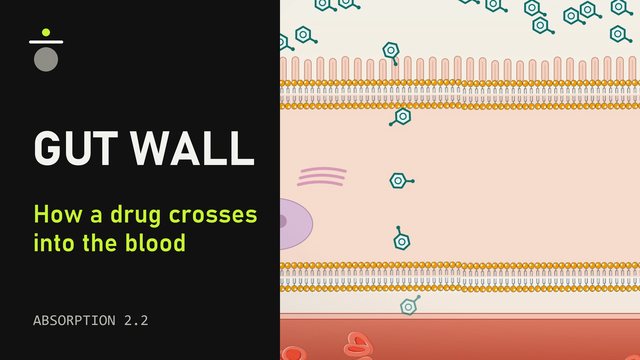
The first organ is the gut wall. In the human small intestine, CYP3A makes up on average about 80 percent of the measured cytochrome P450 protein. CYP3A is a small group of enzymes, and in the gut wall it is mainly CYP3A4. CYP3A4 therefore removes a large part of some drugs in the gut wall. The enterocytes also attach sulfate or glucuronic acid to some drugs. These conjugation reactions add to first-pass metabolism in the gut wall.
2:21The liver
The second organ is the liver. There, CYP3A makes up about 40 percent of the measured P450 protein. Each percentage is a share within one organ. Across the two organs, the enzymes most often involved in first-pass metabolism are CYP3A4, CYP2D6, CYP1A2, CYP2C9 and CYP2C19. CYP1A2 is present in the liver, but the gut wall contains little or none.
2:53Extraction and variability
On the first pass, the liver receives only the drug that escapes the gut wall. The fraction of the absorbed drug that passes both organs is therefore Fg times Fh. The enzyme content varies widely between people, in the gut wall as in the liver. In the small intestines of 31 donors, the CYP3A4 content varied about 17-fold. Enzyme inducers, drugs that increase the amount of an enzyme, raise the content. Disease and diet also change it, and enzyme inhibitors lower the enzyme activity. When an organ removes most of a drug, a small change in its extraction ratio gives a large change in the fraction that escapes. For example, a fall in the extraction ratio from 0.9 to 0.8 doubles the fraction that escapes, from 0.1 to 0.2. A drug with a large first-pass metabolism therefore often has a variable oral bioavailability.
4:08Routes that avoid the first pass
Some routes avoid the first pass. The lining of the mouth has a dense blood supply. Its veins return blood to the heart. Drug that crosses this lining therefore enters the systemic circulation without a passage through the gut wall or the liver. A buccal dose rests between the cheek and the gum, and a sublingual dose rests under the tongue.
4:35Midazolam
Midazolam shows how much drug each organ removes on the first pass. Midazolam is a sedative, and CYP3A metabolizes it. Clinical studies use it as a probe drug for CYP3A, because its blood concentrations depend mainly on the activity of this enzyme. In a study of 20 healthy young adults, each person received 1 milligram intravenously and 2 milligrams orally, in random order. The analysis assumed complete absorption, so Fa was 1. The intravenous dose gave the extraction ratio of the liver, 0.44, so Fh was 0.56. If only the liver removed midazolam, the oral bioavailability would also be 0.56. The measured oral bioavailability was about half of this value. From this difference, the study estimated that the gut wall removed 43 percent of the midazolam that entered it, so Fg was 0.57. The two organs had similar extraction ratios, and the gut-wall value varied more between people. Patients can swallow part of a buccal dose, and that part passes through the gut wall and the liver.
6:04Buccal midazolam
In a second study, eight healthy volunteers received 5 milligrams of midazolam by the buccal route and, on another occasion, intravenously. The study measured the AUC, the area under the plasma concentration-time curve. At equal doses, the ratio of the two AUC values is the bioavailability. The buccal AUC was 74.5 percent of the intravenous AUC, so the buccal bioavailability was 74.5 percent.
6:39Summary
In summary, the gut wall and the liver both metabolize drug before it reaches the systemic circulation. Fg and Fh are the fractions that escape each organ. In the gut wall, CYP3A4 is the main P450 enzyme. Enzyme content varies widely between people, so a large first-pass metabolism often gives a variable oral bioavailability. Drug that crosses the lining of the mouth enters the systemic circulation directly. For midazolam, the gut wall and the liver had similar extraction ratios, and buccal midazolam had a bioavailability of 74.5 percent. This concludes lesson 2.3 on first-pass metabolism.
Sources
- Trevaskis NL, Charman WN, Porter CJ. Lipid-based delivery systems and intestinal lymphatic drug transport: a mechanistic update. Adv Drug Deliv Rev. 2008. PMID 18155316
- Shen DD, Kunze KL, Thummel KE. Enzyme-catalyzed processes of first-pass hepatic and intestinal drug extraction. Adv Drug Deliv Rev. 1997. PMID 10837554
- Varma MV, Obach RS, Rotter C, et al. Physicochemical space for optimum oral bioavailability: contribution of human intestinal absorption and first-pass elimination. J Med Chem. 2010. PMID 20070106
- Paine MF, Hart HL, Ludington SS, et al. The human intestinal cytochrome P450 "pie". Drug Metab Dispos. 2006. PMID 16467132
- Zhang H, Zhang J, Streisand JB. Oral mucosal drug delivery: clinical pharmacokinetics and therapeutic applications. Clin Pharmacokinet. 2002. PMID 12126458
- Thummel KE, O'Shea D, Paine MF, et al. Oral first-pass elimination of midazolam involves both gastrointestinal and hepatic CYP3A-mediated metabolism. Clin Pharmacol Ther. 1996. PMID 8646820
- Kvitne KE, Drevland OM, Haugli N, et al. Intraindividual variability in absolute bioavailability and clearance of midazolam in healthy individuals. Clin Pharmacokinet. 2023. PMID 37162619
- Schwagmeier R, Alincic S, Striebel HW. Midazolam pharmacokinetics following intravenous and buccal administration. Br J Clin Pharmacol. 1998. PMID 9764959
- Darwish M, Kirby M, Robertson P, et al. Absolute and relative bioavailability of fentanyl buccal tablet and oral transmucosal fentanyl citrate. J Clin Pharmacol. 2007. PMID 17322146
Illustrations adapted from Servier Medical Art (smart.servier.com), CC BY 4.0. Structures drawn with RDKit.