Transcript
0:00Renal clearance
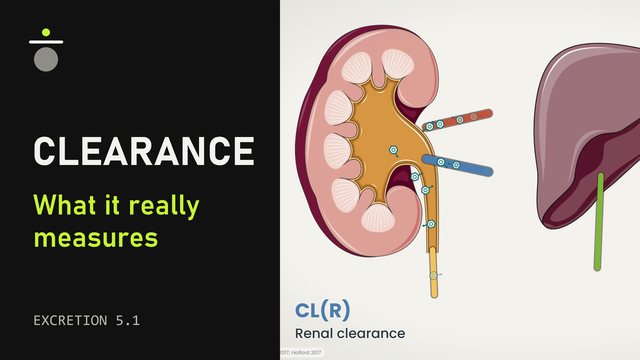
Lesson 5.2 of our excretion module: the kidney. Excretion is the removal of a drug and its metabolites from the body, mainly by the kidneys into urine and by the liver into bile. Plasma is the liquid part of the blood. Renal clearance is the volume of plasma from which the kidneys remove all of the drug per unit of time. It equals the amount of unchanged drug that enters the urine over a time interval, divided by the AUC for the same interval. The AUC is the area under the plasma concentration-time curve.
0:45The nephron
Each kidney forms urine in many small units, the nephrons. Each nephron starts at a glomerulus, a network of small blood vessels inside a capsule. The glomerulus filters plasma into Bowman's space, the space inside the capsule. The filtered fluid then flows along a tubule and becomes urine. The first part of the tubule is the proximal tubule.
1:18Three processes
Three processes set the renal clearance: filtration, secretion and reabsorption. Each process has a clearance: its rate of drug transfer divided by the plasma concentration. Renal clearance equals the filtration clearance plus the secretion clearance minus the reabsorption clearance.
1:42Filtration
The first is filtration. The glomerular filtration rate, GFR, is the volume of plasma that passes from the glomeruli into Bowman's space per unit of time. In a healthy young man, it is about 120 milliliters per minute. Only drug that is not bound to plasma proteins passes into Bowman's space. The filtration clearance therefore equals the fraction unbound in plasma times the GFR.
2:17Secretion
The second is secretion, the transport of drug from the blood into the fluid of the proximal tubule. Transporters, proteins in the cell membranes, carry the drug through the tubule cells. Other drugs can inhibit these transporters. Organic anions, with a negative charge, enter the tubule cells from the blood through OAT1 and OAT3. Efflux pumps such as MRP2 then move them into the tubule fluid. Organic cations, with a positive charge, enter from the blood through OCT2, and MATE1 and MATE2-K move them into the tubule fluid. Secretion can make the renal clearance larger than the filtration clearance.
3:12Reabsorption
The third is reabsorption, the movement of drug from the tubule fluid back into the blood. Most reabsorption is passive. Drug that is lipophilic, or fat-soluble, and un-ionized, without a charge, diffuses back across the lipid membranes of the tubule cells. The ionized fraction of weak acids and weak bases depends on pH, a measure of acidity. Urine pH therefore changes their reabsorption and their renal clearance. At a higher urine pH, a weak acid is more ionized, so less of it diffuses back, and its renal clearance increases.
3:59Creatinine clearance
Clinicians estimate kidney function from creatinine, a waste product mainly from muscle. The glomerulus filters creatinine freely, and the proximal tubule also secretes it. Creatinine clearance is therefore about 10 to 20 percent higher than the GFR, especially when kidney function is low. The Cockcroft-Gault equation estimates the creatinine clearance from age, body weight, sex and serum creatinine. Serum is the liquid part of clotted blood. For many drugs that the kidneys excrete, clinicians adjust the dose to this estimate.
4:42Metformin
Metformin, a drug for type 2 diabetes, shows filtration and secretion. At body pH, more than 99.9 percent of metformin is a cation, so the tubule reabsorbs little of it. Almost none of it is bound to plasma proteins, and the kidneys excrete it unchanged. Its renal clearance is about 510 milliliters per minute, about 4 times the creatinine clearance. Filtration accounts for about 120 milliliters per minute, and secretion by OCT2, MATE1 and MATE2-K for the other 390.
5:26Tucatinib and metformin
Tucatinib, a breast cancer drug, inhibits OCT2, MATE1 and MATE2-K in cells, and in the kidney mainly MATE1 and MATE2-K. In 17 healthy adults, tucatinib lowered the renal clearance of metformin from about 500 to 294 milliliters per minute. The GFR, measured with the filtration marker iohexol, did not change, so the fall came from less secretion. Creatinine clearance fell by 23 percent, because tucatinib also inhibits the secretion of creatinine.
6:09Kidney disease and the metformin dose
In chronic kidney disease, the renal clearance of metformin falls approximately in proportion to creatinine clearance, so the same dose gives higher concentrations. Lactic acidosis, an excess of lactic acid in the blood, is a rare adverse effect, and low metformin concentrations minimize its risk. The dose should therefore fall in proportion to creatinine clearance. Chronic kidney disease has stages, each a range of estimated GFR. One study gave daily doses of 1500 and 1000 milligrams in stages 3A and 3B. These doses kept blood metformin below 5 milligrams per liter, the generally accepted safe upper limit.
7:04Summary
In summary, filtration removes only unbound drug. Secretion by transporters in the proximal tubule can make the renal clearance larger than the filtration clearance. Reabsorption returns lipophilic, un-ionized drug to the blood and depends on urine pH for weak acids and bases. Creatinine clearance estimates kidney function and is higher than the GFR because of secretion. Mainly because of secretion, metformin has a renal clearance about 4 times the creatinine clearance, and its dose falls in proportion to creatinine clearance. This concludes lesson 5.2 on the kidney.
Sources
- Benet LZ, Sodhi JK. Simplifying pharmacokinetics, applying it to drug and dosage form development, and making drug dosage decisions in clinical medicine: the adaptation of Kirchhoff's laws from physics. AAPS J. 2025. PMID 40603610
- Schneider J, Arraf AA, Grinstein M, et al. Wnt signaling orients the proximal-distal axis of chick kidney nephrons. Development. 2015. PMID 26116665
- Chagnac A, Zingerman B, Rozen-Zvi B, et al. Consequences of glomerular hyperfiltration: the role of physical forces in the pathogenesis of chronic kidney disease in diabetes and obesity. Nephron. 2019. PMID 30947190
- Robertson EE, Rankin GO. Human renal organic anion transporters: characteristics and contributions to drug and drug metabolite excretion. Pharmacol Ther. 2005. PMID 16169085
- Topletz-Erickson AR, Lee AJ, Mayor JG, et al. Tucatinib inhibits renal transporters OCT2 and MATE without impacting renal function in healthy subjects. J Clin Pharmacol. 2021. PMID 32989831
- Burckhardt G, Burckhardt BC. In vitro and in vivo evidence of the importance of organic anion transporters (OATs) in drug therapy. Handb Exp Pharmacol. 2011. PMID 21103968
- Shibata M, Toyoshima J, Kaneko Y, et al. A drug-drug interaction study to evaluate the impact of peficitinib on OCT1- and MATE1-mediated transport of metformin in healthy volunteers. Eur J Clin Pharmacol. 2020. PMID 32472157
- Huang W, Czuba LC, Isoherranen N. Mechanistic PBPK modeling of urine pH effect on renal and systemic disposition of methamphetamine and amphetamine. J Pharmacol Exp Ther. 2020. PMID 32198137
- Huang W, Bowman C, Yin M, et al. A review of physiologically based pharmacokinetic modeling of renal drug disposition. Drug Metab Dispos. 2025. PMID 40048993
- Proudfoot AT, Krenzelok EP, Brent J, et al. Does urine alkalinization increase salicylate elimination? If so, why? Toxicol Rev. 2003. PMID 15181662
- Tio MC, Shafi T, Zhu X, et al. Traditions and innovations in assessment of glomerular filtration rate using creatinine to cystatin C. Curr Opin Nephrol Hypertens. 2023. PMID 36444667
- Cockcroft DW, Gault MH. Prediction of creatinine clearance from serum creatinine. Nephron. 1976. PMID 1244564
- Graham GG, Punt J, Arora M, et al. Clinical pharmacokinetics of metformin. Clin Pharmacokinet. 2011. PMID 21241070
- Lalau JD, Kajbaf F, Bennis Y, et al. Metformin treatment in patients with type 2 diabetes and chronic kidney disease stages 3A, 3B, or 4. Diabetes Care. 2018. PMID 29305402
- McQueen RB, Farahbakhshian S, Bell KF, et al. Economic burden of comorbid chronic kidney disease and diabetes. J Med Econ. 2017. PMID 28128669
Illustrations adapted from Servier Medical Art (smart.servier.com), CC BY 4.0. Structures drawn with RDKit.