Transcript
0:00Metabolism and elimination
Lesson 4.1 of our metabolism module: phase 1 and phase 2 metabolism. Metabolism is the chemical change of a drug by enzymes, proteins that make chemical reactions faster. The product is a metabolite. Elimination is the irreversible loss of the drug from the body, by metabolism or by excretion in urine or bile. For many drugs, metabolism is the main route of elimination. Metabolism usually ends the action of the drug. A lipophilic drug dissolves well in fat. The kidney filters such a drug, but much of it crosses back into the blood. Without metabolism, the drug therefore stays in the body longer and can cause toxicity. Metabolism usually forms products that are more water-soluble than the drug. The kidney excretes these products in urine, or the liver excretes them in bile. In some cases, metabolism activates an inactive drug, or forms a reactive metabolite, which binds to proteins and can damage cells. Pharmacologists divide metabolic reactions into two phases.
1:30Phase 1
The first is phase 1, or functionalization. A phase 1 reaction adds or exposes a functional group, a small group of atoms to which phase 2 can attach a molecule. Examples are the hydroxyl, carboxyl, amine and thiol groups. Phase 1 has three main types of reaction: oxidation, reduction and hydrolysis. Oxidation removes electrons from a molecule and often adds an oxygen atom.
2:05CYP enzymes
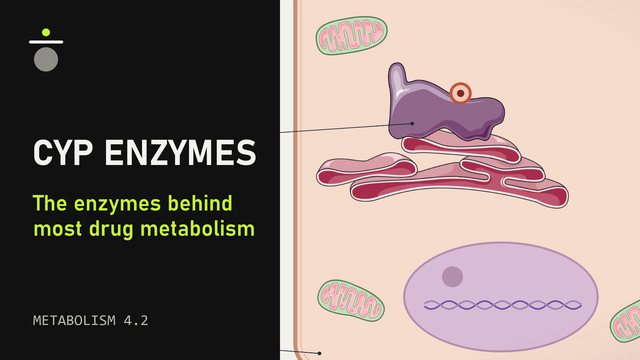
Cytochrome P450 enzymes, or CYP enzymes, carry out most phase 1 oxidations. A typical CYP oxidation uses one oxygen molecule and one NADPH molecule, which supplies two electrons. The enzyme adds one oxygen atom to the drug, and the other oxygen atom, with the two electrons and two hydrogen ions, forms water. In the 200 most prescribed US drugs of 2014, CYP enzymes were 48 percent of the enzymes on major metabolic routes. The human genome contains 57 functional CYP genes in 18 families. Only about a dozen of the enzymes, in families 1, 2 and 3, metabolize most drugs. CYP enzymes are mainly in the liver, and also in the intestine and other organs.
3:12Reduction and hydrolysis
Reduction, the second type, adds electrons to a molecule. Hydrolysis, the third type, uses water to split a bond. An ester bond joins an acid to an alcohol. Esterases, such as the carboxylesterases, split this bond and leave a carboxyl group and a hydroxyl group. A prodrug has little or no activity until the body converts it into the active drug. In two published sets of prodrugs, hydrolysis activated about three quarters of them.
3:52Phase 2
The second phase is phase 2, or conjugation. A phase 2 reaction attaches a small molecule or group of atoms to a functional group. The product is a conjugate. The main ones attached are glucuronic acid, a sulfate group, glutathione, an acetyl group and a methyl group. Glucuronic acid is a sugar acid, and glutathione is a small peptide. Conjugates with glucuronic acid, sulfate or glutathione are more water-soluble than the drug. Phase 2 enzymes are mainly transferases, which move a group from a donor molecule to the drug. Five classes carry out most phase 2 reactions. They are the UDP-glucuronosyltransferases, or UGTs, and the sulfotransferases, or SULTs. The other three are the N-acetyltransferases, the glutathione S-transferases and the methyltransferases. In the same count, enzymes other than CYP, from both phases, were 24 percent. The UGTs were the most frequent of them. A conjugate crosses cell membranes poorly.
5:15Transport of conjugates
Transporters, proteins in the cell membrane that carry molecules across it, move the conjugate out of the liver cell. They move it into the bile, or into the blood for excretion in urine. Some authors call this transport step phase 3.
5:35Paracetamol
Paracetamol shows both phases in one drug. Paracetamol already has a hydroxyl group, so phase 2 enzymes act on most of the dose with no phase 1 step. Four UGTs, UGT1A1, UGT1A6, UGT1A9 and UGT2B15, add glucuronic acid. In adults, mainly SULT1A1 and SULT2A1 add a sulfate group. After a recommended dose, the glucuronic acid conjugate is 52 to 57 percent of urinary metabolites, and the sulfate conjugate is 30 to 44 percent. Both conjugates are inactive, and less than 5 percent of the dose appears unchanged in urine. In a phase 1 reaction, CYP enzymes, mainly CYP2E1, oxidize a small part of the dose to N-acetyl-p-benzoquinone imine, or NAPQI. Glutathione binds this reactive metabolite in a phase 2 reaction and makes it harmless. The products of this route are 5 to 10 percent of urinary metabolites.
6:59Paracetamol overdose
Above 4 grams per day, the maximum recommended daily dose for adults, the sulfate route reaches its maximum rate. UGTs and CYP enzymes then convert a larger share of the dose. After a highly toxic dose, the glucuronic acid route also reaches its maximum rate, and more than 15 percent of the dose forms NAPQI. NAPQI then depletes the glutathione in the liver, binds to proteins in the liver cells and kills these cells.
7:38Summary
In summary, phase 1 adds or exposes a functional group, most often by CYP oxidation. Phase 2 attaches a small molecule or group, most often glucuronic acid, to a functional group. Transporters then move the conjugates out of the liver cell into bile or blood. Paracetamol has a hydroxyl group, so phase 2 conjugates most of the dose directly. CYP enzymes oxidize a small share of the dose to NAPQI. After a highly toxic dose, this share rises, and NAPQI damages the liver. This concludes lesson 4.1 on phase 1 and phase 2 metabolism.
Sources
- Saravanakumar A, Sadighi A, Ryu R, et al. Physicochemical properties, biotransformation, and transport pathways of established and newly approved medications: a systematic review of the top 200 most prescribed drugs vs. the FDA-approved drugs between 2005 and 2016. Clin Pharmacokinet. 2019. PMID 30972694
- Zhao M, Ma J, Li M, et al. Cytochrome P450 enzymes and drug metabolism in humans. Int J Mol Sci. 2021. PMID 34884615
- Varma MV, Feng B, Obach RS, et al. Physicochemical determinants of human renal clearance. J Med Chem. 2009. PMID 19445515
- Almazroo OA, Miah MK, Venkataramanan R. Drug metabolism in the liver. Clin Liver Dis. 2016. PMID 27842765
- Guengerich FP. Mechanisms of cytochrome P450-catalyzed oxidations. ACS Catal. 2018. PMID 31105987
- Zanger UM, Schwab M. Cytochrome P450 enzymes in drug metabolism: regulation of gene expression, enzyme activities, and impact of genetic variation. Pharmacol Ther. 2013. PMID 23333322
- Jancova P, Anzenbacher P, Anzenbacherova E. Phase II drug metabolizing enzymes. Biomed Pap Med Fac Univ Palacky Olomouc Czech Repub. 2010. PMID 20668491
- Mazaleuskaya LL, Sangkuhl K, Thorn CF, et al. PharmGKB summary: pathways of acetaminophen metabolism at the therapeutic versus toxic doses. Pharmacogenet Genomics. 2015. PMID 26049587
Illustrations adapted from Servier Medical Art (smart.servier.com), CC BY 4.0. Structures drawn with RDKit.