Transcript
0:00What is volume of distribution?
Lesson 3.1 of our distribution module: volume of distribution. Distribution is the movement of a drug from the blood into the tissues and back. Plasma is the liquid part of the blood. The volume of distribution, Vd, is the amount of drug in the body divided by the plasma concentration, after distribution is complete. Vd is an apparent volume, and it can be larger than the whole body. Per kilogram of body weight, plasma is about 0.043 liters, and the body water, plasma plus tissue water, is about 0.6 liters. In a 70-kilogram adult, the body water is about 42 liters.
0:58Small and large Vd
Warfarin, a drug that reduces blood clotting, has a Vd of about 0.14 liters per kilogram, or 10 liters in a 70-kilogram adult. Chloroquine, a drug for malaria, had a Vd of 116 to 285 liters per kilogram. In a 70-kilogram adult, this is more than 8,000 liters, almost 200 times the body water.
1:32Unbound drug
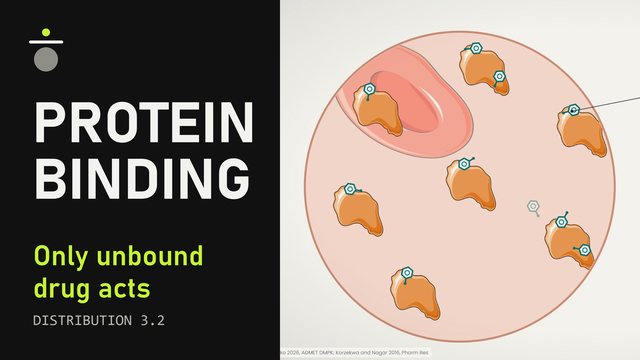
In plasma and in tissue, part of the drug is bound, and the rest is unbound. Only the unbound drug crosses cell membranes and enters the cells of the tissue. If no transporter protein carries the drug and the pH is the same on both sides, the unbound concentrations become equal. The ratio of the unbound tissue concentration to the unbound plasma concentration is Kp,uu, and it is then 1. Three of the factors that change Vd are binding in plasma, binding in tissue and trapping in lysosomes. Lysosomes are small acidic compartments inside cells.
2:24Binding in plasma
The first is binding in plasma. Many drugs bind reversibly to plasma proteins, mainly albumin and alpha-1-acid glycoprotein. Acids are drugs that can give up a proton, a hydrogen ion, and become negatively charged. They bind strongly to albumin and weakly in tissue, so their Vd is usually 0.1 to 0.25 liters per kilogram. Warfarin is an acid that binds to albumin.
3:02Binding in tissue
The second is binding in tissue. In tissue, many drugs bind mainly to phospholipids, the fat-like molecules that form cell membranes. Bases are drugs that can take up a proton and become positively charged. They bind strongly to the negatively charged phospholipids, so they tend to have a larger Vd than acids and neutral drugs. When a drug binds more in tissue than in plasma, its Vd is larger than the body water, 0.6 liters per kilogram.
3:44Trapping in lysosomes
The third is trapping in lysosomes, which have a pH of 5 or lower. A weak base exists in a neutral and a charged form. The neutral form crosses the phospholipid membrane of the lysosome. Inside, at the low pH, it takes up a proton. The charged form crosses the membrane only slowly, so the drug collects inside, a process called ion trapping. Like binding in tissue, ion trapping raises Vd.
4:23Chloroquine
The Vd of chloroquine comes from 11 healthy volunteers who received 300 milligrams by intravenous infusion, a slow injection into a vein. Plasma proteins bind only about 60 percent of chloroquine, so its large Vd comes from tissue. Chloroquine is a weak base, so lysosomes can trap it. Isolated human white blood cells with many lysosomes took up more chloroquine than other blood cells. The authors explain this by trapping in lysosomes.
5:05Vd and half-life
Clearance is the volume of plasma from which the body removes all the drug per unit of time. The terminal half-life is the time for the plasma concentration to fall by half after distribution is complete. A larger Vd gives a longer half-life at the same clearance, and a higher clearance gives a shorter one. The clearance of chloroquine was about 43 liters per hour, more than 200 times that of warfarin. Its terminal half-life was still 146 to 333 hours, or 6 to 14 days, because its Vd is so large.
5:53Summary
In summary, Vd is the amount of drug in the body divided by the plasma concentration, and it can be larger than the body. Binding in plasma lowers Vd, as for warfarin. Binding in tissue raises Vd, as for many bases. Trapping in lysosomes can also raise the Vd of weak bases. At the same clearance, a larger Vd gives a longer half-life. Chloroquine binds in tissue and collects in lysosomes, so its Vd was over 100 liters per kilogram and its terminal half-life over 6 days. This concludes lesson 3.1 on volume of distribution.
Sources
- Gustafsson LL, Walker O, Alván G, et al. Disposition of chloroquine in man after single intravenous and oral doses. Br J Clin Pharmacol. 1983. PMID 6849784
- Ducharme J, Farinotti R. Clinical pharmacokinetics and metabolism of chloroquine. Focus on recent advancements. Clin Pharmacokinet. 1996. PMID 8896943
- Martiney JA, Cerami A, Slater AF. Verapamil reversal of chloroquine resistance in the malaria parasite Plasmodium falciparum is specific for resistant parasites and independent of the weak base effect. J Biol Chem. 1995. PMID 7673225
- Raghoebar M, Peeters PA, van den Berg WB, et al. Mechanisms of cell association of chloroquine to leucocytes. J Pharmacol Exp Ther. 1986. PMID 3723403
- Hraběta J, Belhajová M, Šubrtová H, et al. Drug Sequestration in Lysosomes as One of the Mechanisms of Chemoresistance of Cancer Cells and the Possibilities of Its Inhibition. Int J Mol Sci. 2020. PMID 32575682
- Breiden B, Sandhoff K. Emerging mechanisms of drug-induced phospholipidosis. Biol Chem. 2019. PMID 31408430
- Holford NH. Clinical pharmacokinetics and pharmacodynamics of warfarin. Understanding the dose-effect relationship. Clin Pharmacokinet. 1986. PMID 3542339
- Valko K. Linking biomimetic binding measurements to pharmacokinetic models of volume of distribution and hepatic clearance. ADMET DMPK. 2026. PMID 42100636
- Greenblatt DJ, Zhang Q, Bruno CD, et al. Volume of distribution in pharmacokinetics and clinical medicine: a critical update. J Pharm Pharmacol. 2026. PMID 42247572
- Korzekwa K, Nagar S. Drug Distribution Part 2. Predicting Volume of Distribution from Plasma Protein Binding and Membrane Partitioning. Pharm Res. 2016. PMID 27966088
- Hammarlund-Udenaes M, Fridén M, Syvänen S, et al. On the rate and extent of drug delivery to the brain. Pharm Res. 2008. PMID 18058202
- Uchida Y, Ohtsuki S, Katsukura Y, et al. Quantitative targeted absolute proteomics of human blood-brain barrier transporters and receptors. J Neurochem. 2011. PMID 21291474
- Smith DA, Beaumont K, Maurer TS, et al. Volume of Distribution in Drug Design. J Med Chem. 2015. PMID 25799158
- Smith D, Beaumont K, Maurer TS, et al. Insights on Volume of Distribution of Acids. J Med Chem. 2025. PMID 40762691
- Bteich M. An overview of albumin and alpha-1-acid glycoprotein main characteristics: highlighting the roles of amino acids in binding kinetics and molecular interactions. Heliyon. 2019. PMID 31844752
- Yim DS. Tutorial for beginners: the concept of clearance explained using the example of a vacuum cleaner. Transl Clin Pharmacol. 2017. PMID 32095451
- Toutain PL, Bousquet-Mélou A. Plasma terminal half-life. J Vet Pharmacol Ther. 2004. PMID 15601438
- Abernethy DR, Greenblatt DJ. Phenytoin disposition in obesity. Determination of loading dose. Arch Neurol. 1985. PMID 3994563
Illustrations adapted from Servier Medical Art (smart.servier.com), CC BY 4.0. Structures drawn with RDKit.